
RELATIONSHIP & SEXUAL VIOLENCE PROGRAM
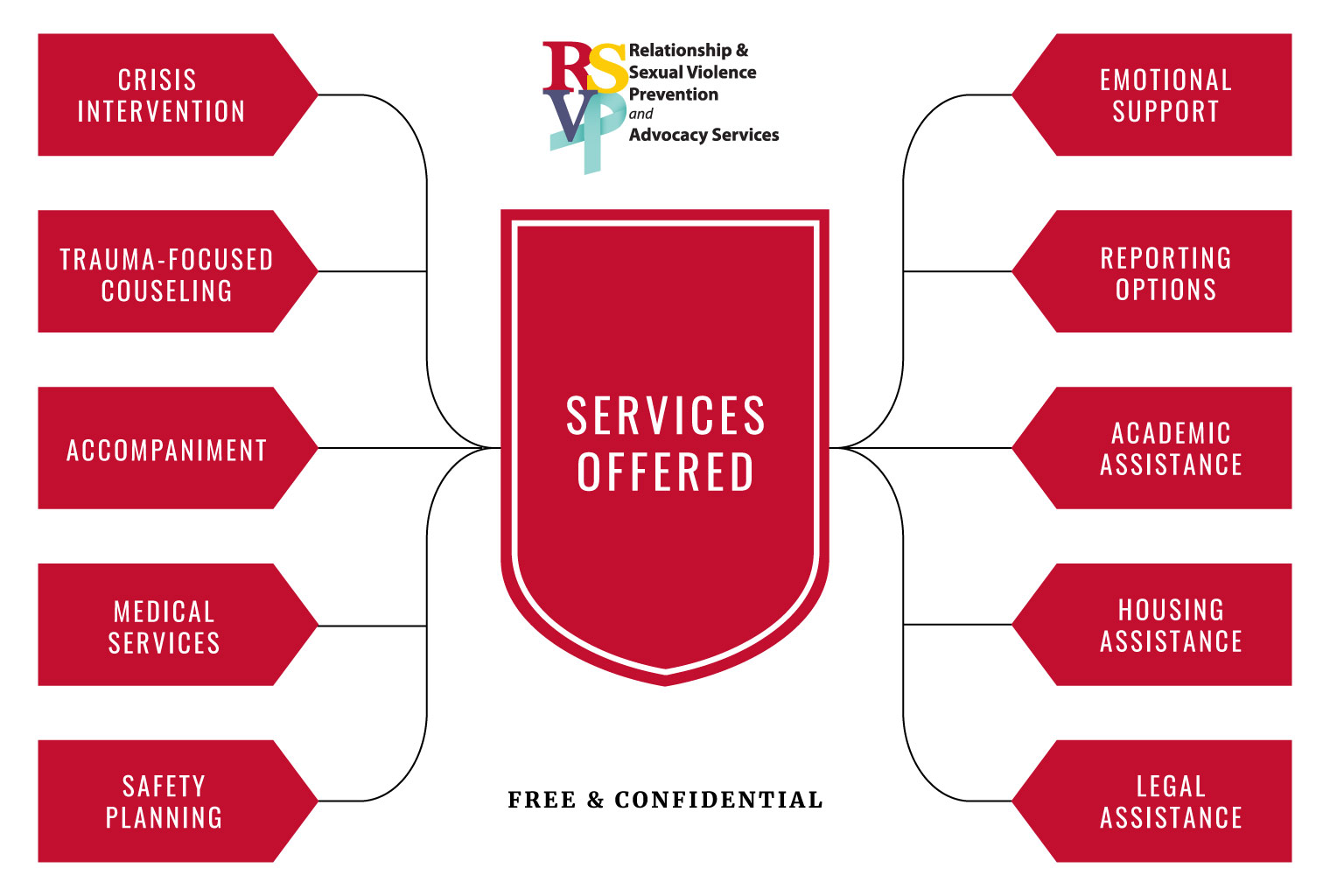
SERVICES OFFERED:
If you have experienced any of these victimizations, UGA students have access to a 24/7 hotline 706-542-2273 for support and crisis intervention. An RSVP advocate will walk you through your options via phone, create a safety plan (if needed) and offer to accompany you in-person if you would like to file a police report or complete a medical exam. You are also welcome to stop by The Fontaine Center located in the University Health Center during office hours Monday – Friday, 8:00am to 5:00pm.
UGA also offers the Counseling and Psychiatric Services (CAPS) hotline (706) 542-2733 that can provide UGA students with counseling services 24/7 if you have memories or nightmares regarding your trauma.
If you have experienced any of these victimizations and would like to file a police report or complete a medical exam, you have the right to have an advocate present for support. For police reports, contact law enforcement and let them know you want to file a report and would like an advocate to attend the interview. For medical exams, your advocate can assist with the arrangements. Please know that medical exams for sexual assault are not completed at the local hospitals (Piedmont/St. Mary’s).
If you need immediate medical attention, please go to your local hospital (Piedmont/St. Mary’s). They will be able to assess your injuries and treat you. However, they are not able to perform medical exams for sexual assault. Anyone who has experienced sexual violence within the past 120 hours or 5 days may be eligible for a free forensic evidence collection exam, called a SANE (Sexual Assault Nurse Examination). Survivors 18 and older are not required to file a report with law enforcement to have this exam performed. You have the right to have an advocate accompany you during this exam, and an RSVP advocate will schedule this exam for you. SANE nurses can also prescribe STI preventive medications after your examination at no cost.
Additionally, RSVP advocates are able to discuss options regarding medical treatment through the University Health Center. If you are a survivor of sexual assault and do not want a SANE exam, you are able to get STI preventative medications through the University Health Center. Advocates can help survivors explore financial resources for HIV testing.
If you have experienced any of these victimizations, RSVP advocates will discuss counseling options with you. There are several counseling options both on- and off-campus and at varying costs, including counseling at no cost to the survivor. We are happy to assist the survivor in this process at any point along their recovery journey.
UGA also offers the Counseling and Psychiatric Services (CAPS) hotline 706-542-2273 that can provide UGA students with counseling services 24/7 if you have memories or nightmares regarding your trauma.
Safety planning is a proactive process that involves identifying potential hazards, assessing risks, and developing strategies to manage and reduce those risks as much as we can to create a safer environment. Safety plans can be helpful for anyone, but particularly those experiencing domestic or dating violence or those experiencing stalking. Please reach out to RSVP if you would like to learn more or create a safety plan for yourself. They are also available in our resource library.
Our advocates provide compassionate, survivor-centered emotional support to individuals impacted by relationship and sexual violence. We offer a safe, non-judgmental space where survivors can share their experiences at their own pace and be heard, believed, and validated. Emotional support from our advocates may include:
- Active listening and affirmation
- Helping survivors identify and express their feelings
- Safety planning and support during moments of distress
- Helping make informed decisions about reporting or support services
- Offering encouragement and reassurance as survivors navigate their options
While our advocates do not provide clinical counseling or long-term therapeutic services, we can connect survivors with licensed counselors and other mental health professionals for more in-depth trauma processing and ongoing care.
Survivors have a variety of options for reporting including UGA specific reporting and Legal/Law Enforcement. RSVP advocates will discuss all reporting options with the survivor to allow them to make an informed decision. RSVP will never pressure a student to make any type of report as we find it important for the survivors to do what will be best for them and their healing process. When a student does decide to report, an advocate is available to attend any meetings with police, school officials, investigators or court personnel, at the survivor’s requests.
RSVP advocates may be able to work with your professors and teaching staff to secure flexibility with assignments, class attendance and other coursework. Please know that while we can request flexibility, this is ultimately at the discretion of your instructors, and any contact with professors/faculty will be limited in detail to protect your confidentiality.
Temporary housing or dorm changes may be possible, but are not guaranteed. If it is an emergency, please contact our after-hours advocates to discuss your options. Otherwise, please call, stop by, or schedule an appointment with an advocate at the Fontaine Center located at the University Health Center (706) 542-8690 during business hours, Monday to Friday 8:00am to 5:00pm, to discuss which options would help you with your current situation.
Advocates can discuss the option of filing a Temporary Protection Order (TPO), including what it is, how it works, and what protections it can provide. Additionally, we can connect survivors with further legal advice and support through the Family Justice Clinic to help them better understand their rights and legal options. When a student does decide to report, an RSVP advocate is available to attend any meetings with police, school officials, investigators, or court personnel, at the survivor’s requests.
- Healthy Relationships
- Self-Care
- Consent
- Internet Safety/Exploitation
- Secondary Survivors
- Stalking/Harassment
VICTIMIZATION TYPES:
Students will often hear and see the term sexual misconduct, which is the broad term encompassing sexual exploitation, sexual harassment, non-consensual contact, non-consensual sexual intercourse, dating and domestic violence and stalking. While the university identifies these violations using certain terms, some may identify their experience as rape, sexual assault or sexual abuse. The focus here is on sexual assault to include non-consensual sexual contact and non-consensual sexual intercourse, which can be generally described as an unwanted experience of a sexual nature, ranging from unwanted touching to unwanted penetration.
UGA Student Code of Conduct
Sexual assault is a violation of the Student Code of Conduct.
The Student Code of Conduct contains the Non-Discrimination and Anti-Harassment Policy, which offers complete definitions for sexual harassment. This policy also contains information about reporting, the review process, and potential sanctions.
https://policy.uga.edu/policies#/programs/Skc7ETvS6
Georgia Law
While Georgia law defines and names these behaviors differently from the university, sexual assault is against the law according to Georgia Code. When referencing searching for sexual offenses, use the search term 16-6. Students will find information about laws, potential punishments, and sentencing parameters.
Occurs when an individual takes non-consensual or abusive sexual advantage of another for his or her own advantage or benefit, or to the benefit or advantage of anyone other than the one being exploited.
Examples of sexual exploitation may include, but are not limited to, the following
- Invasion of sexual privacy;
- Prostituting another individual;
- Non-consensual photos, video or audio of sexual activity;
- Non-consensual distribution of photo, video or audio of sexual activity, even if the sexual activity or video or audio taken of sexual activity was consensual;
- Intentional observation of nonconsenting individuals who are partially undressed, naked, or engaged in sexual acts;
- Knowingly transmitted an STD or HIV to another individual through sexual activity;
- Intentionally and inappropriately exposing one’s breasts, buttocks, groin, or genitals in non-consensual circumstances; and/or
- Sexually based bullying
UGA Student Code of Conduct
Sexual exploitation is a violation of the Student Code of Conduct.
The Student Code of Conduct contains the Non-Discrimination and Anti-Harassment Policy, which offers a complete definition for sexual exploitation. This policy also contains information about reporting, the review process, and potential sanctions.
https://policy.uga.edu/policies#/programs/Skc7ETvS6
Georgia Law
While Georgia law defines and names these behaviors differently from the university, some types of sexual exploitation are against the law according to Georgia Code. When referencing sexual exploitation, use the search term 16-6. Students will find information about laws, potential punishments, and sentencing parameters.
It is not always easy to tell at the beginning of a relationship if it will become abusive. In fact, many abusive partners may seem absolutely perfect in the early stages of a relationship. Possessive and controlling behaviors do not always appear overnight but rather emerge and intensify as the relationship grows.
Domestic violence does not look the same in every relationship because every relationship is different. But one thing most abusive relationships have in common is that the abusive person displays a pattern of behaviors to gain power and control. Domestic violence is not just limited to romantic partners but can come from family, roommates, friends, etc. Some of those behaviors may include, but are not limited to:
- Physically harming someone
- Showing jealousy of friends and time spent away
- Keeping or discouraging someone from seeing friends or family members
- Embarrassing or shaming someone with put-downs
- Controlling every penny spent in the household
- Taking someone’s money or refusing to give them money for expenses
- Looking at someone or acting in ways that scare them
- Controlling who someone sees, where they go or what they do
- Preventing someone from making their own decisions
- Telling someone that they are a bad parent or threatening to harm or take away their children
- Preventing someone from working or attending school
- Destroying their property or threatening to hurt or kill their pets
- Intimidating someone with guns, knives or other weapons
- Pressuring someone to engage in sexual activity when they do not want to or are not comfortable.
Information provided by National Domestic Violence Hotline
Students who are beginning to feel as if their partner or a loved one’s partner is becoming abusive should watch out for these red flags. Students who are experiencing one or more of these behaviors in their relationship are welcome to contact RSVP at the Fontaine Center for support.
UGA Student Code of Conduct
Abuse is a violation of the Student Code of Conduct.
The Student Code of Conduct contains the Non-Discrimination and Anti-Harassment Policy, which offers a complete definition for Dating Violence and Domestic Violence. This policy also contains information about reporting, the review process, and potential sanctions.
https://policy.uga.edu/policies#/programs/Skc7ETvS6
Georgia Law
While Georgia law defines and names these behaviors differently from the university, some types of domestic violence are against the law according to Georgia Code. Georgia refers to domestic violence as family violence. When referencing family violence, use the search term 19-13. Students will find information about laws, potential punishments, and sentencing parameters.
Sexual harassment is unwelcome sexual advances, requests for sexual favors and other verbal or physical conduct of a sexual nature that affects an individual’s work or school performance or creates an intimidating, hostile or offensive work or school environment.
Examples of conduct that may constitute sexual harassment to the extent it meets either of the above definitions, without limitation:
- Nonconsensual touching of another’s body, including unwanted hugging or shoulder rubbing.
- Sexual remarks, jokes, anecdotes, inquiries, or physical gestures. 3. Requests or propositions of a sexual nature. 4. Gender or sex-based comments or comments of a sexual nature (either complimentary or insulting) about a person’s physique, clothing, or sexual/romantic activity or preferences. 5. Inappropriate use, display, or non-consensual sharing of sexual images, text, or objects
Circumstances surrounding sexual harassment include:
- Student and harasser may be of same or different gender
- Women may perpetrate sexual harassment
- Harasser may be a supervisor, an agent of the employer, a supervisor in another area, a co-worker or a non-employee
- The survivor does not have to be the person that is directly harassed. It may be anyone affected by the offensive conduct.
- The harasser’s conduct must be unwelcome
UGA Student Code of Conduct
Sexual Harassment is a violation of the Student Code of Conduct.
The Student Code of Conduct contains the Non-Discrimination and Anti-Harassment Policy, which offers complete definitions for sexual harassment. This policy also contains information about reporting, the review process, and potential sanctions.
https://policy.uga.edu/policies#/programs/Skc7ETvS6
Georgia Law
While Georgia law defines and names these behaviors differently from the university, some types of sexually harassing behaviors are against the law according to the Georgia Code. When referencing sexual offenses, use the search term 16-6. More specifically, the Georgia Code references Sexual Assault by Persons with Supervisory or Disciplinary Authority as 16-6-5.1. Students will find information about laws, potential punishments, and sentencing parameters.
Students may also reference information regarding Title VII of the Civil Rights Act of 1964 and Title IX of the Education Amendments of 1972, which highlight federal regulations for sexual harassment in the workplace and educational settings.
Discriminatory harassment: Unwelcome verbal or physical conduct based on age, color, disability, genetic information, national origin, race, religion, sex, or veteran status when it is sufficiently severe, persistent, or pervasive to:
- Unreasonably interfere with the individual’s work or educational performance;
- Create an intimidating, hostile, or offensive working or learning environment;
- Unreasonably interfere with or limit one’s ability to participate in or benefit from an institutional program or activity.
UGA Student Code of Conduct
Discriminatory Harassment is a violation of the Student Code of Conduct.
The Student Code of Conduct contains the Non-Discrimination and Anti-Harassment Policy, which offers complete definitions for harassment. This policy also contains information about reporting, the review process, and potential sanctions.
https://policy.uga.edu/policies#/programs/Skc7ETvS6
Georgia Law
Georgia law classifies harassment under code section 16-11-39.1 (harassing communication). Students will find information about the law, potential punishments, and sentencing parameters under this code section.
https://law.justia.com/codes/georgia/title-16/chapter-11/article-2/section-16-11-39-1/
There are federal regulations in place that prohibit harassment, such as Title VII of the Civil Rights Act of 1964 and Title IX of the Education Amendments of 1972, The Age Discrimination in Employment Act of 1967, and The Americans with Disabilities Act of 1990, which highlight federal regulations for harassment.
Hazing is any activity expected of someone joining or participating in a group that humiliates, degrades, abuses or endangers them, regardless of a person’s willingness to participate. Hazing can occur within sororities and fraternities, athletic teams, and other organizations. It is important to report any instance of hazing, whether directly experienced or witnessed.
UGA Student Code of Conduct
Hazing is a violation of the Student Code of Conduct.
The Student Code of Conduct offers complete definitions for hazing. This policy also contains information about reporting, the review process, and potential sanctions.
https://policy.uga.edu/policies#/programs/Skc7ETvS6
Georgia Law
While Georgia law defines and names these behaviors differently from the university, hazing is against the law according to the Georgia Code. When referencing specific laws such as hazing, use the search term 16-5-61.
https://law.justia.com/codes/georgia/title-16/chapter-5/article-4/section-16-5-61/
Discrimination: Decision-making based on age, color, disability, genetic information, national origin, race, religion, sex, or veteran status. Other examples that may constitute discrimination as defined above include, without limitation:
- Hiring, termination, promotion, salary actions, and other employment decisions based on protected categories, i.e. race, sex, disability, etc.;
- Assigning grades, or making academic decisions based on protected categories, such as race, sex, disability, etc.; and/or
- Refusing acceptance or admission to a person with a disability without consideration of accommodations
UGA Student Code of Conduct
Discrimination is a violation of the Student Code of Conduct.
The Student Code of Conduct contains the Non-Discrimination and Anti-Harassment Policy, which offers complete definitions for Discrimination. This policy also contains information about reporting, the review process, and potential sanctions.
https://policy.uga.edu/policies#/programs/Skc7ETvS6
Federal Law
There are federal regulations in place that prohibit discrimination, such as Title VII of the Civil Rights Act of 1964 and Title IX of the Education Amendments of 1972, The Age Discrimination in Employment Act of 1967, and The Americans with Disabilities Act of 1990, which highlight federal regulations for discrimination.
https://www.eeoc.gov/statutes/title-vii-civil-rights-act-1964
Childhood abuse encompasses various forms of harm inflicted on children, including physical, emotional, sexual abuse, and neglect, often leading to long-term psychological effects.
UGA Student Code of Conduct
While childhood abuse cannot be addressed by the student code of conduct, the university is still happy to connect students with support resources such as counseling.
Georgia Law
For offenses committed between July 1, 1992 and June 30, 2012, if the alleged victim of one of the following offenses is under 16 years of age, the statute of limitations (seven years) shall not begin to run until the victim has reached the age of 16 or the violation is reported to law enforcement:
- Cruelty to children, O.C.G.A. § 16-5-70;
- Rape, O.C.G.A. § 16-6-1;
- Sodomy or aggravated sodomy, O.C.G.A. § 16-6-2;
- Statutory Rape, O.C.G.A. § 16-6-3;
- Child molestation or aggravated child molestation, O.C.G.A. § 16-6-4;
- Enticing a child for indecent purposes, O.C.G.A. § 16-6-5;
- Incest, O.C.G.A. § 16-6-22;
For offenses committed on and after July 1, 2012, if the alleged victim of one of the following offenses is under 16 years of age and the offense is not being prosecuted as a misdemeanor, there is no statute of limitations, and a prosecution may be commenced at any time:
- Trafficking a person for sexual servitude, O.C.G.A. § 16-5-46;
- Cruelty to children in the first degree, O.C.G.A. § 16-5-70;
- Rape, O.C.G.A. § 16-6-1;
- Aggravated sodomy, O.C.G.A. § 16-6-2;
- Child molestation or aggravated child molestation, O.C.G.A. § 16-6-4;
- Enticing a child for indecent purposes, O.C.G.A. § 16-6-5;
- Incest, O.C.G.A. § 16-6-22;
If you are aware of ongoing child abuse, you should report it. Reporting helps protect children from continued harm and ensures that appropriate authorities can intervene.
Want to read more about what RSVP has to offer?
Please review our RSVP Toolkit
Want to hear more about what RSVP is about?
Please listen to our Podcast Episode
Feel free to walk into our office anytime Monday-Friday 8am - 5pm and ask to speak to an RSVP advocate. We are located in the Fontaine Center on the first floor of the UHC.
24 hour hotline: 706-542-SAFE (7233)
For any questions or general information, please call 706-542-8690.
FREQUENTLY ASKED QUESTIONS
RSVP serves all UGA affiliated students who identify as a survivor of interpersonal violence and/o sexual assault. RSVP also serves individuals who identify as secondary survivors such as roommates, friends, and/or loved ones.
RSVP services are free and confidential. This means that the only way individuals will know if you’ve engaged with RSVP is if you tell them or give RSVP the consent to contact individuals/departments on your behalf. We take confidentiality very seriously at RSVP as survivors do not need to have an additional worry on their plate.
At RSVP we do not blame the survivor for what has occurred and this information does not change the services you receive. We support survivors no matter the circumstances. If law enforcement reports are made, these items will not be held against the survivor as our campus and community partners care about the crime that occurred against the survivor rather than getting the survivor in trouble.